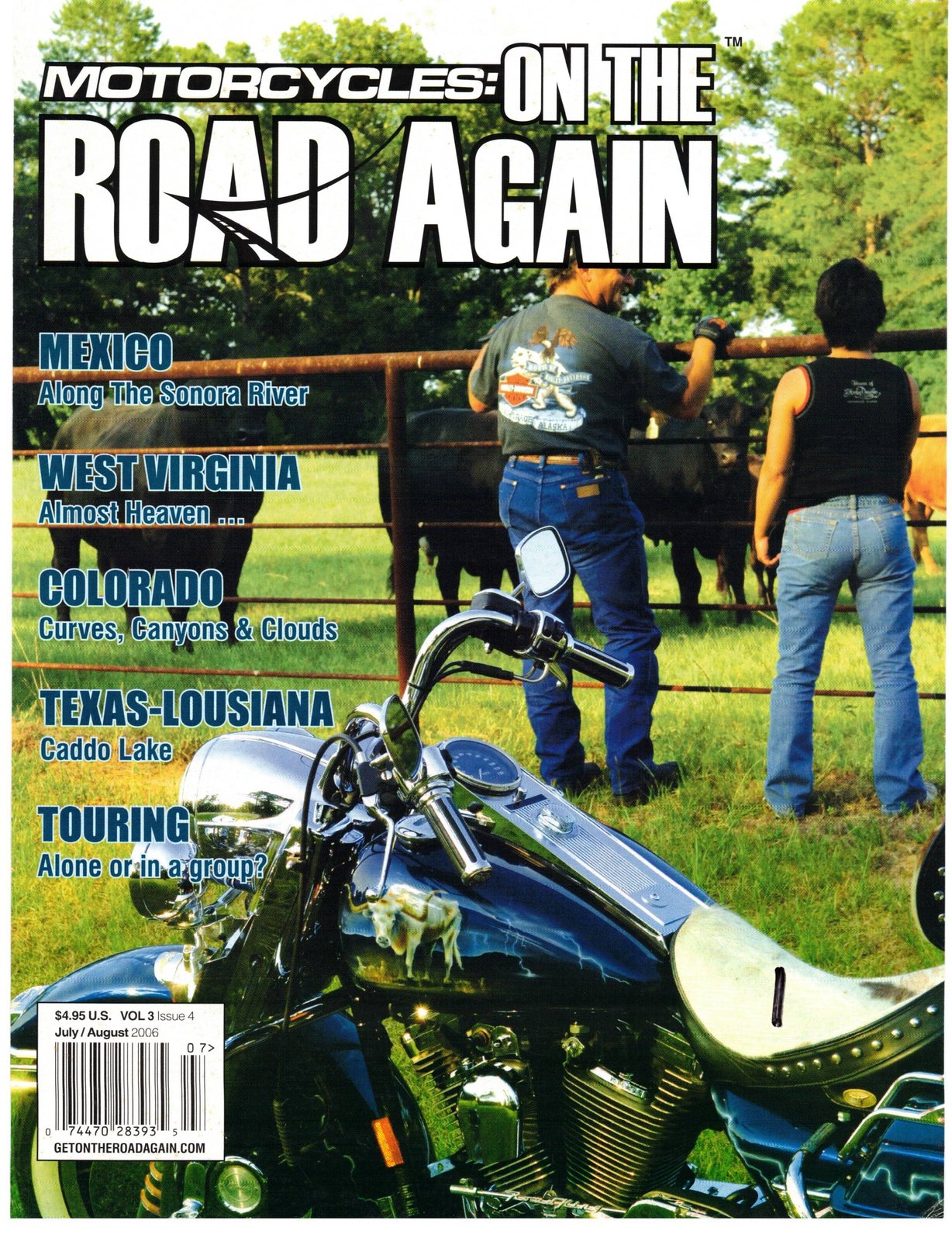
Originally published in Motorcycles On The Road Again, August 2006.
Sonora, Mexico Tom Matthews
The sky is supercharged on sunshine. The grass grows tall on the sides of the road where there is no shoulder. Tar strips and patches thump a rhythm out as we ride into a different age, seemingly a past era. The border is behind us; ahead is the vast expanse of the Sonoran Desert and the Ruta del Rio Sonora — the Route of the Sonora River.
Getting to the border was a journey back in time, first Tombstone, Arizona and the old west, then Bisbee, and the bygone age of wealth pulled from the copper mines. The Copper Queen Hotel still sits as the centerpiece of the town, maintaining with it the air of the heady days when Bisbee was the largest city between St Louis and San Francisco. Bisbee is now reemerging in a mini real estate boom as the town has been re-cast as a haven for artists.
Leave Bisbee and head south towards Mexico. Crossing the border at the twin towns of Naco, Arizona and Naco, Sonora is easy: work your way through the maze of concrete road barriers on the U.S. side, slow down at the gate and be waved through into Mexico.
For the true flavor of Mexico it is best to proceed directly out of Naco, as border towns are neither American nor Mexican but a strange clashing confluence of the two. The road heading out is narrow and a solid mass of patches yet not uncomfortable riding. There are a few
SUBSCRIBE , GETOHTHEROAOAGAIN.COM potholes but maneuvering the bikes around them is not a problem. Soon the intersection of Mexico Highway 2 appears and now we travel west.
The road surface is good but no shoulders. There is light traffic, a mix of cars, farm trucks and semis. Cananea, a working class copper mining town; this is no Bisbee or even what Bisbee once was; it's a hardscrabble city of 30,000 working El BAJIO
ABOVE: ROAD TO MAGDELANA class people. We sweep around an insane intersection and head south again. The Sonora beckons and the clock seems to wind in reverse as we enter the undiscovered Mexico, untrammeled by tourists or littered with fast food or hotels chains.
Running between the tall dry grasses growing right up to the edge of the pavement on either side of the road feels like a Hot Wheel's
THIS PAGE TOP: NUESTRA SENORA DE LA ASUNCIÖN TEMPLE, ARIZPE, SONORA
THIS PAGE BOTTOM: ROCK FORMATIONS ALONG THE SONORA RIVER NEXT PAGE BOTTOM: ARIZPE, SONORA track. This is the "Ruta del Rio Sonora." The river cuts a valley along the foothills of the Sierra Madres and the road climbs up from the valley floor and back down again. Small towns, poblados, appear with small homes of adobe on the outskirts. The town centers all have a main square and a church and most were founded in the mid-1600s. Narrow streets, laid out centuries before pickups parked here, front the neat houses of adobe. Many are in disrepair and need paint, reflecting the lingering after affects of the currency devaluation and recession of 1994, but there are splashes of new paint and new construction.
The Sonora River is cattle country and small herds of cows graze along the roadside and often in the road. Rounding a curve to find an 800-pound steer on the roadway can get the adrenaline up. It is dry. The last rains were in August and the winter rains of January never appeared. The sun in February is gaining strength and it is a long time until the monsoons of July. The vegetation is stressed, it's winter and brown shrubs are mixed among the gray green cactus on the hillsides.
Along the top of the valley and to the east, the high peaks of the Sierra Madre are visible. It is strange for me, as a Coloradoan, to see mountaintops with no snow. We can see the thin wisp of the river peeking in and out of the band of green vegetation along the banks below. The road climbs and falls along the valley twisting through narrow road cuts where the rocks have fallen and landed on the pavement. The sound of the cruisers rises and falls as we throttle up and down through the turns and as we climb and drop along the valley.
We ride overwhitewashed bridges and cross through river fords where there are no bridges. Some of these "vados" are dry, some with a 3-inch deep flow across the concrete. At the entrance to the towns and on the main streets there are "topes" or speed bumps. Some of these are huge and require a near stop and a slight diagonal crossing on a cruiser.
Motorcycles are not all that common and don't go unnoticed. The people are friendly and wave; cars flash their lights. Drivers will switch on their left turn signal to indicate it's safe to pass, unless they put it on to make a left turn.
One hundred-thirty miles from Bisbee, Banamichi appears in the slanting late afternoon light. We roll down past the city park where a large stone covered with prehistoric drawings is held on the shoulders of four giant limestone warriors. A right and down two blocks to the town square we find la Posada del Rio Sonora, home base for our stay.
The Posada orinn is a restored 200year-old adobe structure. The owners, Bill Harmsen and his wife, Irma Rojo, bought the property five years ago, stabilized the ruins and rebuilt the structure into a small hotel with eight rooms and two apartments. Today, the inn presents a brightly painted facade on the town square. The rooms face the interior courtyard complete with a fountain and a large avocado tree. The rooftop terrace over the restaurant is complete with a canopy and affords a fantastic view of the town, the Sierra Madre and the river valley with a fire pit for cool winter evenings.
The rooms are unique — colorful tile and wonderful furnishings collected from all over the world. Every room is different and each has a private shower with plenty of hot water. The restaurant, which features a 300-year-old door from Pakistan, is only open for guests of the Inn and serves authentic Mexican breakfast and dinners prepared by Irma and her staff.
There was no need to worry about leaving the bikes parked at the curb. There is almost no crime in this area of Mexico. Small towns here are just like small towns anywhere — people know everyone in town and know everything that goes on. The stories of banditos roaming the countryside seem to be false as well. None of the locals had heard of any incidents. We did hear (unconfirmed) of an attempted robbery in the Sierra but the thief was bought off for fifty dollars and went away.
Dinner and an evening spent on the terrace were the prelude to comfortable beds and a great night's sleep. We begin the morning with coffee and breakfast and then a ride to Arizpe. Founded in the 1630's, Arizpe is the home of the historic Nuestra Senora de la Asunci6n Temple. Construction began on the temple in 1646 and it features the bones of the explorer Juan Bautista de Anza who died in 1788. Juan's bones are there for all to see; six feet down under glass in the floor of the chapel. Small homes line narrow streets, some paved with cobblestones, some concrete. The houses are stucco over adobe or block and few have front or side yards. Some are faded and the adobe is eroding but many have been freshly painted. Flowers are everywhere. After Arizpe and contemplating the bones of the dead explorer, it's back to the Banamichi and lunch, a hamburgesa at a small restaurant near the posada. This will be a lazy day with some more exploring, a walk through the town, another fine meal as we end the evening on the terrace.
A quick breakfast and off to Magdalena De Kino. North on the Ruta Del Rio Sonora towards Arizpe then northwest on the "Ruta De Misi6ns," the route of the Missions, at Sinoquipe. The road is good, still no Shoulders and dry desert landscape. All the streams are dry, the fields are dry, skinny cows roam the dry range looking for grass. Organ pipe cacti are everywhere, tall stalks in arrays like insanely dense candelabras of green. Now the road climbs and curves above the arroyos. We spot a ranch hand on horseback riding along the road — no ranch, no town in sight. The bikes lean into the "twisties" through road cuts and down through the ford in the stream, the Rio El Valle is a river of sand crossed by another whitewashed bridge.
The town of Curcupe, home of the Ruines de Misi6n Antiquas, translated: The Ruins of the Old Mission. All that remains are the bell, a few THIS PAGE TOP: LA POSADA DEL RIO SONORA – BANAMICHI, SONORA
PREVIOUS PAGE TOP: WARRIOR, TOWN PARK, BANAMICHI crumbling walls and two amazing brick arches. The original mission was founded in 1644. Jesuit Padre Eusebio Kino, the man who brought Christianity to Sonora was at the mis- Sion in 1687. The mission was abandoned when the Franciscans drove out the Jesuits though attempts were made later to rebuild.
From Curcupe, the road continues to twist as it rises and falls through the parched landscape. Ahead, we encounter a checkpoint looking for drugs and illegal arms. In desert uniforms with automatic weapons, the demeanor of the young soldiers appears quite serious. Once the bikes are stopped and the words "Touristas?" and "Si" are exchanged, they smile. No search this time, the saddlebags go untouched as they wave us on. I see the driver of the car behind us step out of the vehicle as the soldiers stick their heads inside to search.
The vegetation changes, more scrub and the road cuts through a forest of saguaro cactus. The hillsides are covered with these desert giants, their arms sometimes beckoning us and other times in strange poses. In the bodies of the cactus are holes bearing the nests of Gila woodpeckers and gilded flickers. The mature plants can reach 45 feet tall and weigh up to 6 tons. The first arms sprout at 50 years and the oldest of the saguaro can be 200 or more years old. The turnouts on the road are few but with almost no traffic, a quick stop on the pavement allows for a photo or two.
Soon there are more signs of human habitation; a ranch, a feedlot, a rodeo arena as we near the town of
Magdalena. A city of 31,000, Magdalena is only 63 miles from Nogales and gets more US tourists. Magdalena. although not founded by Padre Kino he was the driving force in its development. Kino, an Italian who explored northern Sonora and Arizona and converted the Pima Indians to Christianity, died in the city in March of 1711. His remains, long the subject of a search by those wishing to canonize him, were discovered in Magdalena in 1966. The Plaza of Monuments was completed in 1970 to house his crypt. Today the plaza is busy with tourists and locals enjoying the day visiting the crypt, the church and the ice cream shops. Vendors catering to tourists abound. This is a tourist area and there are undesirables here; we we lock our bike.
We eat lunch at a small seafood restaurant and have time to grab a bottle of KahlÖa and as many botties of wine as can fit in the saddlebags and its time to head back to the Posada. The traffic of Magdalena gives way to the lonely highway and the saguaros. Los militares recognize the gringos on "motos" and wave and smile. The late afternoon sun lights the desert and the whitewashed bridges reflect its glow.
Today we head south along the Sonora from Banamichi to Mazocahui and Highway 14. Now turn Northeast on the Ruta de Sierra Madres, land of Humphrey Bogart, Walter Houston and lost gold mines. No mines on this ride, but the reward is a great road. The first hint is a sweeping "S" curve that climbs from the river valley. Altitude is gained in steps. Looking back from the switchbacks, the green stripe of the river valley is visible. The dryness is pervasive as the bikes climb. More dry riverbeds, and more streams as we head down into valleys then back up. A bit more traffic, this is a major route from Agua Prieta to Hermisillo but for much of the ride the road is
The view open up and the high ridges lay before us. Throughout the curves and switchbacks we make it to Moctuzuma. There are mines here, gold and other metals are extracted from the hills. Ranching is also a large part of the economy. The village plaza is home to a flea market today, has very few tourist trinkets, but mainly has household goods, CDs and DVDs; another hard working town. School has just let out and the more adventurous make a detour to get a closer look at the bikes. There are shared smiles and a chance for the kids to practice their English phrases on the Gringos.
Gas at the local Pemex station (the only station — Pemex is the gasoline monopoly) for some excellent quality fuel. On from MOCtUZUma and off the main highway the traffic is nil. More switchbacks and expan- Sive views. The Rio Bavispe is an oasis, a broad plain with green fields. More Milatares near the town of Huasabas. Before they can speak, THIS PAGE TOP LEFT: FORDING THE SONORA RIVER AT A 'VADO' they're are peppered with questions asking directions in our limited
No inspections but
"Spanglish". some pointing and gesturing. Huasabas and Granados, were to the right, Huachinera, straight ahead. Huasabas was only a few kilometers away. The town was neat and clean, PREVIOUS PAGE TOP: THE SIERRA MADRES the Plaza small and the church unimposing. The town was deserted. The small restaurants ands stores all closed. On to Granados to find the same situation. It was after lunch – "Siesta time".
Finally we found a small store open and for $3 loaded up on cookies and juice. We then headed for Huachinera. Here the road narrows and grows steeper carving through rock spire with switchback after switchback. This is true mountain riding; this is good. It's afternoon and the days are still short. A turnout at what appears to be the high point allows one last photo op and a U-turn. Back down the twisties, one last wave at the checkpoint and back to the Posada in a race against the setting sun.
Night riding in Mexico is risky with no lights to help you see cattle, horses, various other animals and vehicles without lights.
Dinner at the Posada was shrimp with angel hair pasta and lots of wine. Music on the terrace by the fire was a special ending to another outstanding day.
Today, Ures, once the capital of Sonora. We begin by retracing the route south through Aconchi then Baviacora. The road is straight through farm fields, some irrigated, lots of cattle. Passing a pig farm is never pleasant. Stop at the town plaza in Baviacora, where the church, built in the 1940's presents a mishmash of styles. Right next-door is the old adobe church, now facing ruin although there seems to be on-going efforts to stabilize it. Even in decay, the old church has character.
Past Mazocahui and again the road climbs, clinging to the side of the valley. Sweepers and tight turns with sharp drop-offs and few guardrails. Here and there lies a car or pickup that has gone over at some time and never retrieved. They are left in place because its too difficult and expensive or perhaps as an object lesson. The excitement of the narrow mountain road is heightened by the oncoming buses driving at insane speeds yet miraculously staying on their side of the centerline.
The road flattens out and an unattractive plain appears. Away from the Sonora, it is dry and dusty though irrigated orange groves show as a sea of green in the dust. Unlike the other towns along the Rio Sonora, this town is not on the main road, and the outskirts populated by ugly buildings housing car repair shops and other small businesses. A side trip to the town plaza shows a different face, well-kept homes and shops, the square dominated as always by a church. Outside the town are several large haciendas. The road continues on to Hermisillo, the capital of Sonora and home to over a million people.
Riding in a foreign city holds little appeal so we retrace our steps back to Banamichi, stopping for side trips in the towns along the way back. We make it an early day and have time to enjoy one last afternoon at the posada with our hosts.
Morning comes and we have a quick breakfast before heading home. The bikes are packed and goodbyes are said and we point the bikes north to the border, back to Cananea, then Naco.
At the border the guards ask few questions and soon we are in Bisbee.
Reluctantly the bikes are loaded onto the trailer and the clock leaps forward to current time.
The road towards home is wider, the signs once again in English as we head north.
We ride back towards the Colorado winter and cold weather but always with an eye in the review mirror, for we already feel the Rio Sonora calling us back.
THIS PAGE BOTTOM: JUAN PABLO, LILLIAN AND FRANCISCO THIS PAGE TOP:THE RUTA DEL MISIONS
View the original scanned article (PDF)