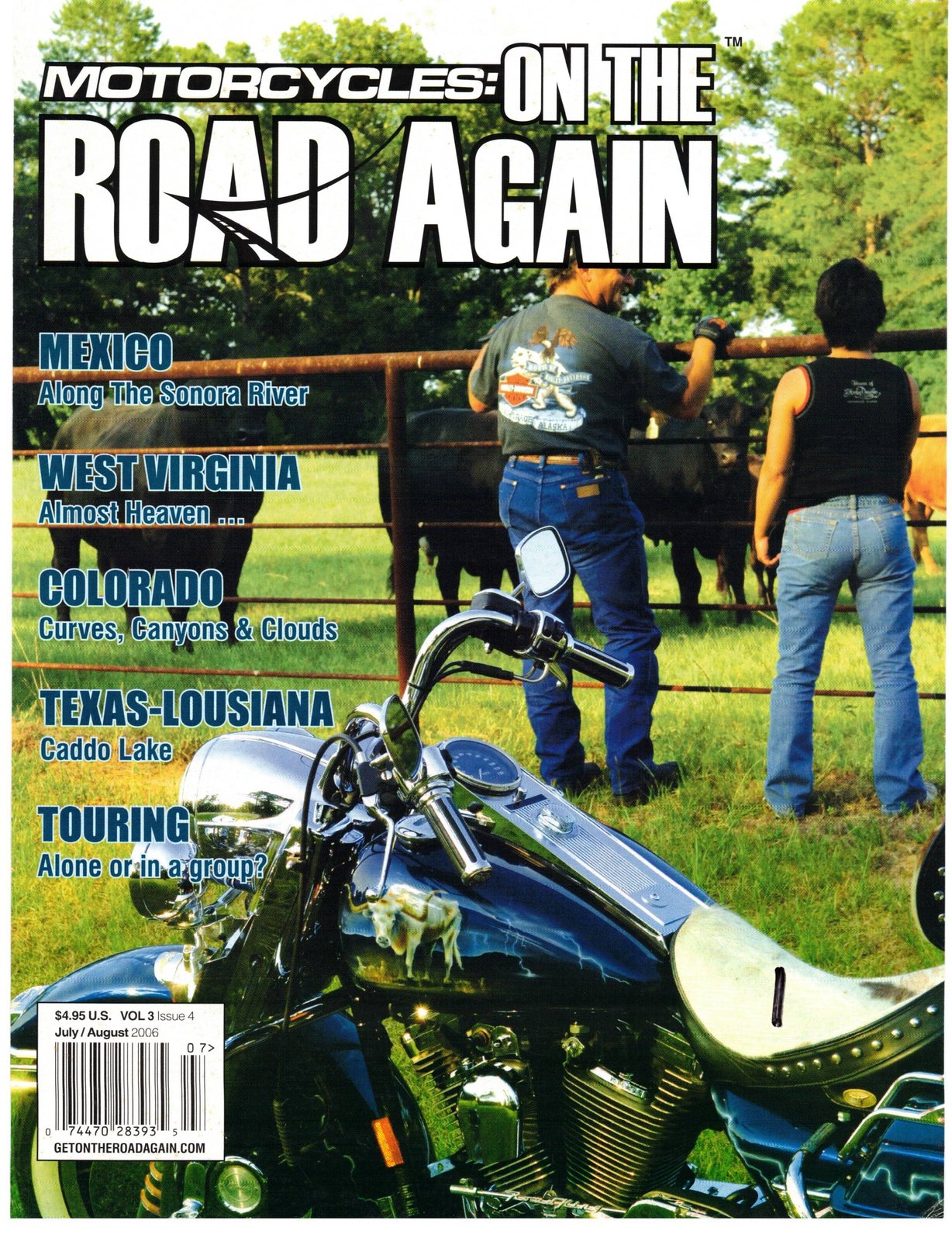
Originally published in Motorcycles On The Road Again, August 2006.
Alone Or In A Group
Dale Borgeson
You have to decide if you're going to travel alone or with others. There are advantages and disadvantages to both choices. I like both depending on my mood and who the others may be. During the past five years I've found that whenever I travel alone I get rained on about half the time I'm on the bike, sometimes more. If I travel with someone else I never even take out my rain suit, even when I can see thunderstorms on all points around me. There may be some cosmic meaning here but I'm too dense to figure it out.
Touring Alone
If you travel alone you can do whatever you want whenever you want. This can be very nice. You also tend to make much better time high mileage days are MUCH easier when you're alone. It's also easier to find a place to sleep since you only have to satisfy your own motel or campsite requirements.
On the down side there is no one to talk to on breaks or during meals. If you breakdown you're on your own. You're also more vulnerable to the crazies and the local rednecks that like to mess with bikers. This isn't common but it still happens.
Touring In A Group
In a group there is more security and people to talk to but at the price of lowest common denominator behavior and decision-making. The degree to which this is a problem varies with your personality and that of your travel companions. Remember that the IQ of a group is the IQ of the dumbest person in the group divided by the number of people in a group. As a consequence, groups can do some pretty stupid things things that the individual members would never do on their own.
You will not make as high an average speed in a group as you would alone. This is true for ALL groups regardless of makeup. With a group all stops will take longer. On average planned stops for groups take the planned amount of time plus a minimum of an extra 5 minutes for each bike beyond one.
You can see that for large groups once you stop you run the risk of not leaving until it's time to go home. This rule is true for day trips, multi-month tours, and everything in between.
You must also consider the frequency of stops, also known as the pose factor. Posers are not touring motorcyclists. They seldom ride more than a couple thousand miles (3200 km) a year, mostly from their house to the nearest biker hangout and back. To them a serious road trip is about 100 mi (160 km). Don't get me wrong, I have nothing against posers, per se, many of them are really nice people.
It's just that if you want to actually ride your motorcycle having posers in your group can be really frustrating as they always have some silly reason to stop. They say things like "we've been riding nonstop for 50 miles (80km) and I need a break." On a day-trip this can drive you nuts but on a cross country jaunt it can ruin the experience (unless you're the person who wants to stop).
Fortunately, most posers have no desire to go on long trips. By the way, posers are not limited to a particular brand or category of motorcycle. They are not limited to any particular profession or socioeconomic strata although lawyers do seem to be over represented. They are just people who are not into long distance riding. That's fine as long as you don't expect them to.
Some Rules For Group Touring
Pick your group carefully. If you pick the wrong group you'll be miserable, or they will be, or both. The wrong group is one where not all the members follow the same rules. It doesn't matter so much what the rules are just that everyone follows them. If there are no known rules then no one can (or will) follow them and therefore EVERYONE will be unhappy. If you don't want to follow other peoples' rules, don't ride in a group. If you're in a group of squids don't get angry if they ride too fast – they're squids and that what squids do. Don't say I didn't warn you!
There are some rules that apply to all groups. All groups have to have some way of keeping together. There are two common methods.
Before you leave a stop decide where the next stop will be so that the laggards and speed freaks can be reunited with the group.
The leaders stop at the next turn and don't leave until the last bike gets there.
There are variations on both these methods but the important thing is that some method is chosen, communicated to all the group's members, and followed by everyone. This is important!
There is a third method that many groups follow – everyone will stay together on the road so we don't have to do one of the first two listed above. This-almost-ngy-er
Be willing to leave the group if things get too bad. On a day trip this isn't a big deal but on a two-week trip it can be a substantial problem. The best way to make it possible to leave is to be self-contained. That means no shared resources, everything you will need is on your bike at all times, not on someone else's. If you decide to leave and you need an hour to unload everyone's bike to redistribute all the stuff so that you can leave, this will just increase the bad feelings. If it's a quick "I'm going to take off, have a good trip." things will go a lot easier. By the way if you do decide to leave the group always tell someone that you're leaving.
For long distances, groups of more than four are pretty much unmanageable. If you must travel with more than four bikes break up into smaller groups on the road and plan to meet using rules one or two listed above. I prefer two to three bikes in a group.
Whether you choose to ride alone orin a group, you should always keep safety in mind. Remember that motorcycles are much less forgiving of mistakes than cars are. Stay awake, stay alert and stay out of trouble.
View the original scanned article (PDF)